· Akira Agent
When should an AI voice agent hand off to a human? A practical playbook for service businesses
AI voice agents should not handle every call. This playbook shows service businesses how to set handoff rules for urgent issues, angry customers, low confidence, and sensitive data.
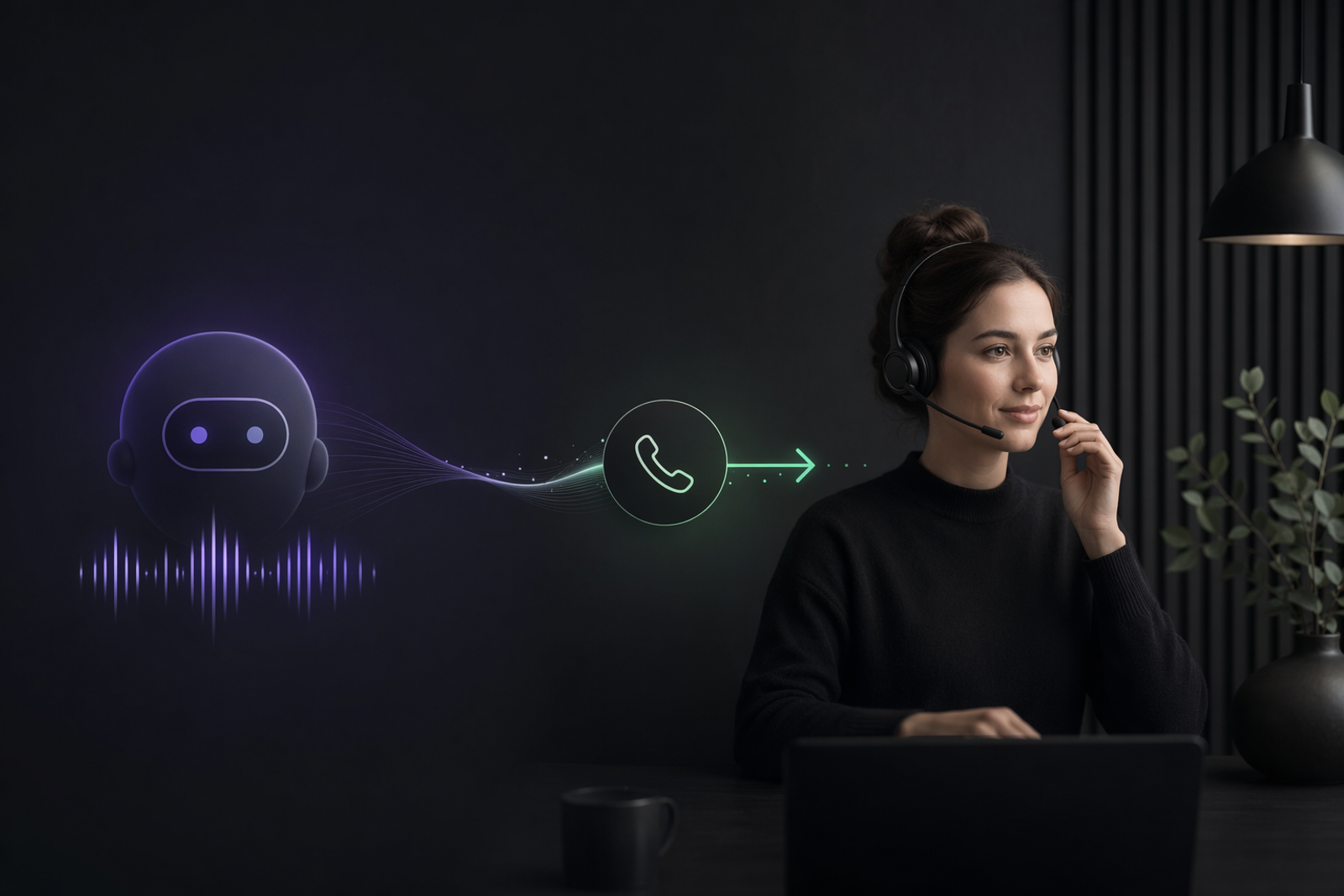
The safest AI voice agent is not the one that tries to handle every call. It is the one that knows when to stop.
That sounds less exciting than "fully autonomous customer service", but it is what works in real service businesses. A restaurant does not want an AI arguing with an angry guest. A recruiter does not want an AI making judgment calls about a candidate. An installer does not want an AI giving safety advice during an electrical problem.
The job of a voice agent is to handle the repetitive parts: answer, identify the request, collect details, check simple rules, create a booking or ticket, and summarize the call. Human handoff rules decide where the machine steps aside.
Why handoff rules matter
A bad handoff feels worse than no automation. The customer repeats everything. The staff member receives no context. The AI keeps talking when the caller needs a person. That is how businesses conclude that "AI does not work" when the real issue was poor workflow design.
A good handoff is different. The AI recognizes the trigger, tells the caller what will happen next, and sends the team a useful summary: who called, what they need, what has already been asked, and why the call was escalated.
That is the difference between a gimmick and an operational tool.
The calls an AI should normally hand off
Every business needs its own rules, but these categories are common.
Urgent safety issues. If a caller mentions smoke, electrical danger, water damage, break-in risk, medical symptoms, or anything that sounds unsafe, the AI should not improvise. It should collect minimal details and escalate.
Angry or distressed customers. If the caller is upset, the goal is not to "win" the conversation. The AI should acknowledge the issue, collect enough context, and move the case to a person.
Refunds, disputes, and complaints. These often require judgment, policy interpretation, and relationship handling. AI can summarize the issue. A human should decide.
Low-confidence conversations. If the AI cannot classify the request, does not understand the caller, or receives conflicting information, it should say so and route the call.
Sensitive personal data. Some workflows involve health information, financial details, recruitment notes, tenant information, or other data that needs tighter controls.
High-value leads. If a call is likely to be a valuable deal, a custom agent can flag it for immediate callback instead of treating it like standard admin.
Live transfer, callback, or ticket?
Handoff does not always mean a live transfer.
A live transfer fits urgent or high-value calls when someone is available. A callback works when the team is busy but needs to respond quickly. A ticket or CRM task works for lower-urgency requests, provided the AI collected enough detail.
The handoff type should match the risk and the customer's expectation. A burst pipe does not belong in a generic inbox. A request to move an appointment probably does.
What the handoff summary should include
A useful handoff summary is short and structured.
It should include:
- caller name and contact details
- requested service or issue
- urgency level
- key facts already collected
- booking or quote preferences
- reason for escalation
- transcript or recording link if your policy allows it
- recommended next action
The staff member should not need to replay the entire call to understand what happened.
Compliance and oversight
Voice agents can process personal data. The European Data Protection Board has guidance on virtual voice assistants here: https://www.edpb.europa.eu/our-work-tools/our-documents/guidelines/guidelines-022021-virtual-voice-assistants_en. The Swedish Authority for Privacy Protection also publishes GDPR guidance for organizations: https://www.imy.se/en/organisations/data-protection/.
For some AI systems, human oversight is also a broader regulatory theme. The EU AI Act is published here: https://eur-lex.europa.eu/eli/reg/2024/1689/oj. Not every service-business phone agent will fall into the same risk category, but the direction is clear: businesses need to know what their AI system does, where humans remain in control, and how customers are informed.
That does not mean every small company needs a legal department before testing AI. It does mean handoff rules should be written down before launch, not invented after the first bad call.
A simple handoff matrix
Before building an AI voice agent, create a table with four columns:
- Call type
- AI can handle?
- Escalation trigger
- Human next step
Example:
Booking change: AI can handle if slots are available. Escalate if the customer is angry, asks for compensation, or needs a policy exception.
Quote request: AI can collect details. Escalate if urgent, unclear, outside service area, or high-value.
Complaint: AI can acknowledge and collect facts. Escalate every time.
Payment dispute: AI can identify the account and reason. Escalate every time.
Emergency issue: AI can collect location and callback number. Escalate immediately.
This matrix becomes the guardrail for the build.
Where Akira fits
Akira Agent builds custom AI agents around real workflows, not generic demo scripts. For voice agents, that usually means connecting the phone flow to calendars, CRMs, inboxes, booking tools, and staff handoff rules.
If you are still deciding whether voice or chat fits the workflow, read https://www.akira-agent.com/blog/what-s-the-difference-between-ai-chatbots-and-voice-agents. For GDPR basics, use https://www.akira-agent.com/blog/gdpr-safe-ai-agents-sweden-service-business-checklist. If call routing is the main issue, compare it against Akira's service pages such as https://www.akira-agent.com/hospitality and https://www.akira-agent.com/installers.
Book the audit
In a 30-minute audit, we can map your top call types and mark each one as AI-handled, AI-assisted, or human-only. That gives you a safer launch scope and avoids the expensive mistake of automating calls that should never have been automated.