· Akira Agent
GDPR-safe AI agents in Sweden: a checklist for service businesses
A plain-English checklist for Swedish service businesses that want AI agents for calls, bookings, CRM updates, and customer follow-up without ignoring GDPR risk.
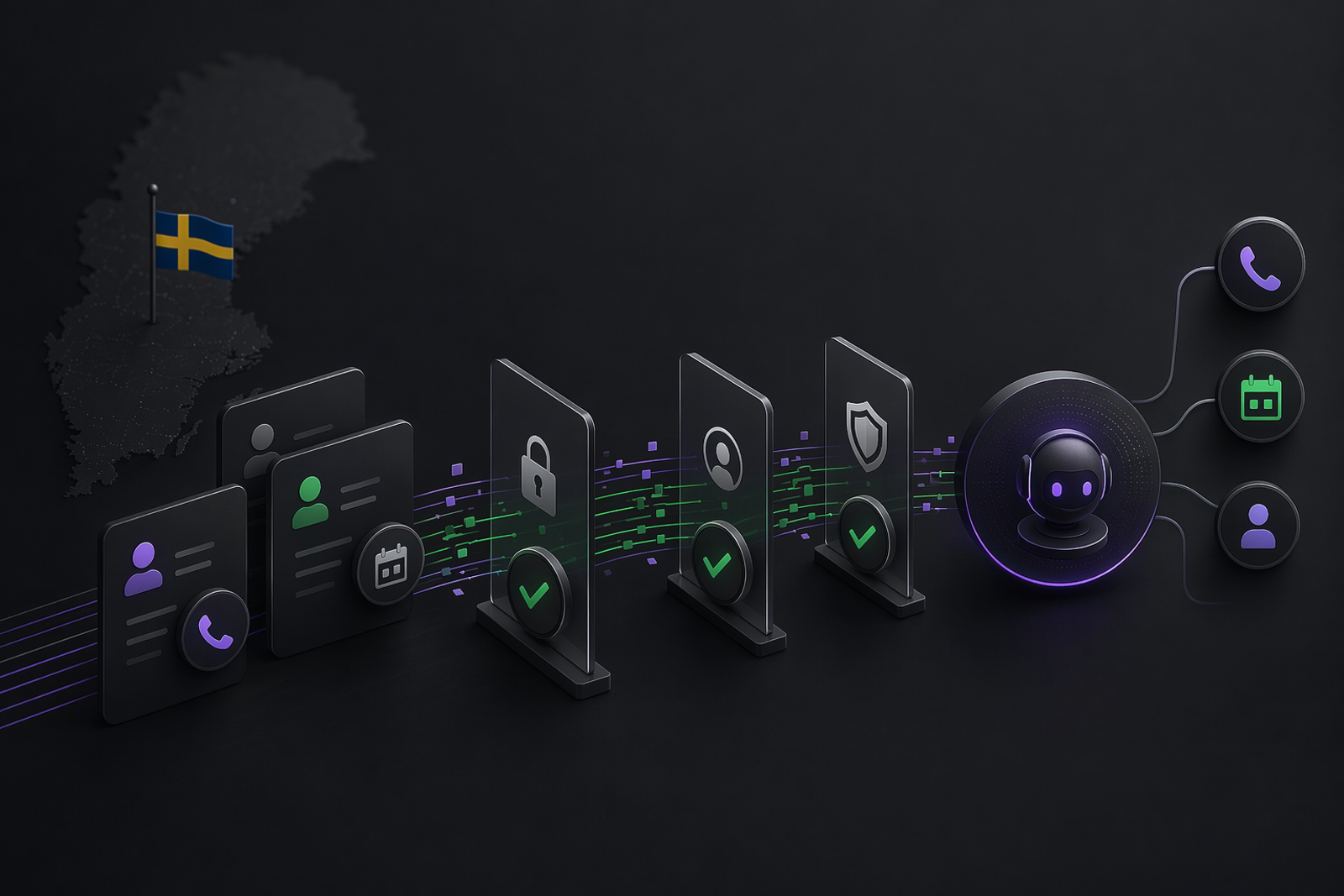
Swedish businesses can use AI agents for calls, bookings, customer questions, and internal workflows. GDPR does not ban that. It does make the setup less casual than "connect the bot to everything and see what happens."
That is a good thing.
An AI agent that touches customer data needs boundaries: what it can see, what it can store, when it deletes data, and when a human steps in. If those rules are clear, an agent can reduce admin without turning privacy into a guessing game.
This checklist is for service businesses in Sweden that want practical automation without pretending GDPR is someone else's problem.
First, list the personal data the agent will touch
Do this before talking about models or features. Write down the data categories.
For a phone or booking agent, that might include:
- name
- phone number
- email address
- booking time
- address
- service request
- free-text notes
- call transcript or summary
- CRM history
- payment or invoice reference
Some workflows are simple. Others are sensitive. A restaurant booking is not the same as a clinic intake, a recruitment conversation, or a legal dispute. If the agent might handle special-category data or vulnerable customers, slow down.
Know who is responsible
IMY, the Swedish Authority for Privacy Protection, explains that the controller decides why and how personal data is processed. In a typical service-business setup, your company remains responsible for the customer data, even if a vendor helps process it. IMY has a useful guide on AI and personal data responsibility.
That means the vendor cannot be your entire privacy policy. You still need to know what the agent does.
IMY's English GDPR overview also states that organisations processing personal data need to follow the GDPR principles and inform people about processing, as described in This applies according to GDPR.
The buyer checklist
Before connecting an AI agent to customer systems, ask these questions.
1. What is the purpose?
"Improve customer service" is too vague. "Answer missed calls, collect booking details, and create a task for staff when the request is unusual" is better.
A narrow purpose makes it easier to choose data, retention, permissions, and handoff rules.
2. What data is necessary?
An agent should not collect everything just because it can. If the goal is to book an appointment, it may need name, contact details, service type, location, and preferred time. It probably does not need a long free-text life story.
Data minimisation is not just a legal phrase. It also makes the agent easier to test.
3. Where is the data processed and stored?
Ask where call transcripts, summaries, logs, and CRM updates are stored. Ask whether data leaves the EU/EEA. Ask what subprocessors are involved.
If a vendor cannot answer plainly, do not connect high-risk workflows yet.
4. Is there a data processing agreement?
If a vendor processes personal data on your behalf, you need the right contractual setup. For many buyers, this is the moment to involve whoever handles legal, privacy, or compliance.
This article is not legal advice. It is a workflow checklist so you know what to ask before buying.
5. How long is data kept?
A call summary may be useful for a week. A booking record may need to live in your booking system. Raw transcripts may not need long retention at all.
Decide retention by workflow. Do not accept indefinite storage by default.
6. Can customers access, correct, or delete data?
GDPR rights do not disappear because an AI agent collected the information. You need a way to find, export, correct, or delete personal data when required.
7. What should the agent never do?
This is where many implementations get safer fast.
Examples:
- do not discuss medical advice
- do not quote a final price without review
- do not reject candidates
- do not handle complaints about legal or financial disputes
- do not continue if the customer sounds distressed
The agent should know when to stop.
8. What gets logged?
Good logging helps you review mistakes. Bad logging creates another privacy pile.
Log what you need for quality control, troubleshooting, and accountability. Avoid storing unnecessary raw data forever.
A simple risk score before launch
Score each workflow from 0 to 2.
- clear purpose
- limited data collection
- processor agreement available
- retention rules set
- deletion/export path exists
- human handoff defined
- access controls in place
- test logs reviewed before launch
A score below 9 means you should pilot with a lower-risk workflow first. A score from 9 to 12 may be fine for an internal or limited pilot. A score from 13 to 16 is closer to customer-facing readiness, assuming your legal/privacy review agrees.
The numbers are not law. They are a practical way to stop teams from skipping the boring checks.
Why this matters commercially
Privacy is already a barrier to AI adoption. SCB reported in its 2025 enterprise IT statistics that data protection and privacy concerns were cited by 49.1% of companies that considered but did not use AI, in the section on barriers to AI use: SCB IT usage in enterprises 2025.
That concern is reasonable. But it should lead to better implementation, not paralysis.
The safest first pilots
Start with workflows where the data is limited and the stakes are manageable:
- basic call routing
- booking requests
- FAQ answers based on approved information
- quote intake without final pricing
- follow-up reminders
- internal summaries reviewed by staff
Be more careful with health, employment, finance, children, legal matters, and anything involving sensitive personal data.
For voice-heavy workflows, this pairs well with the questions in what to ask before hiring an AI voice agent.
What Akira checks before building
A good AI-agent build starts with a data map:
- what the customer says
- what the agent extracts
- where the summary goes
- who reviews exceptions
- when data is deleted
- which systems the agent can update
Then the handoff rules get written in plain language. A safe agent is not one that answers everything. It is one that answers the right things and escalates the rest.
The practical answer
GDPR-safe AI agents are possible in Sweden, but the setup has to be intentional. Start narrow. Collect less data. Keep logs under control. Define human handoff. Review the pilot before widening access.
If you are not sure whether your workflow is safe to automate, book a 30-minute Akira Agent audit. We will map the data flow, identify the risky points, and decide whether an AI agent is worth building now.