· Akira Agent
AI recruiting assistant for staffing agencies: screening, scheduling, and ROI
A practical guide for staffing agencies using AI agents to reduce recruiter admin, speed up candidate follow-up, and keep humans in charge of hiring judgment.
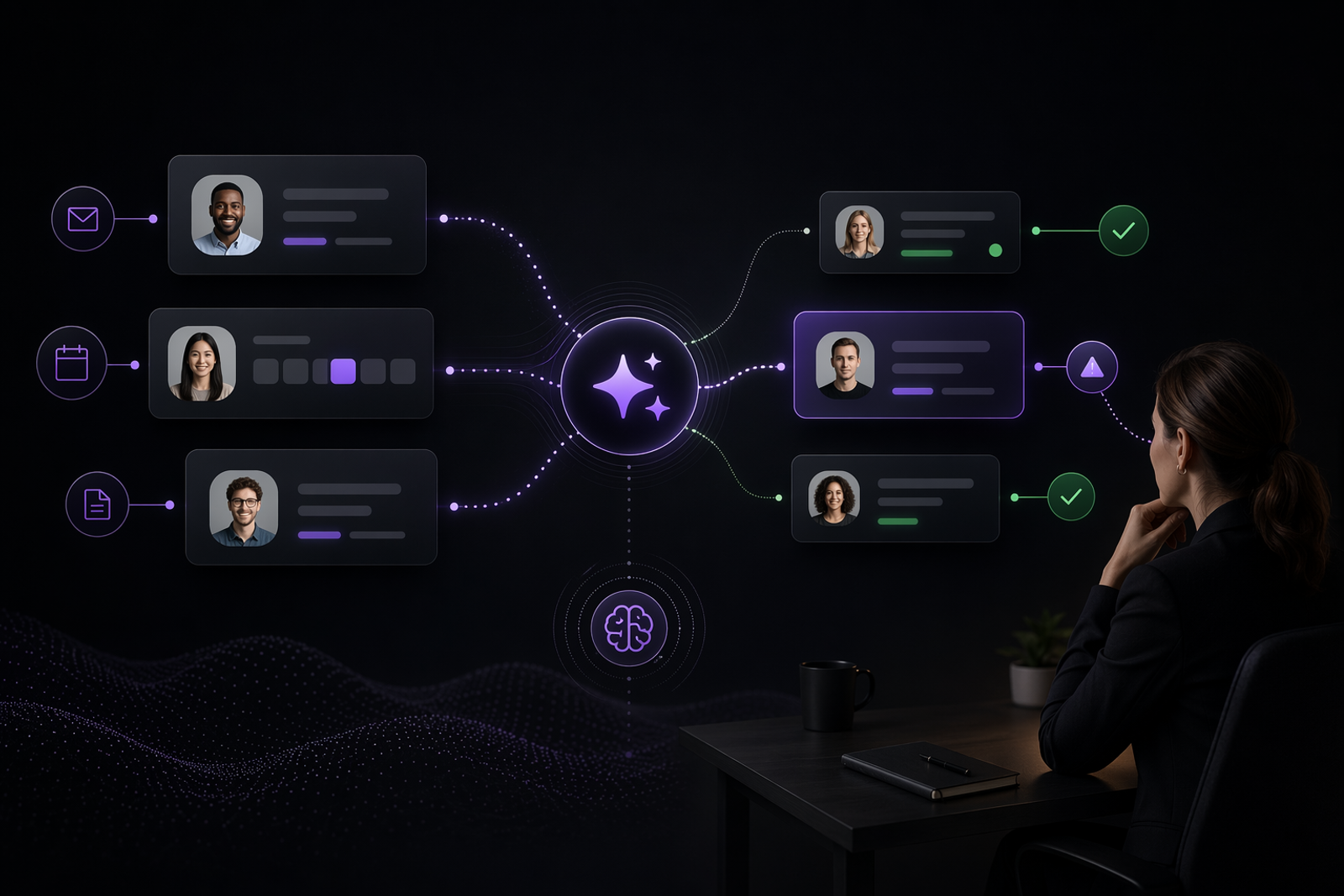
Recruiters do not need AI to tell them whether a person is good. They need relief from the admin around that judgment: screening questions, interview scheduling, reminders, candidate follow-up, ATS updates, and the little status messages that pile up until Friday disappears.
That is where an AI recruiting assistant can help a staffing agency.
The useful version is not a black-box hiring machine. It is an operations agent that keeps candidates moving while recruiters stay responsible for the relationship and the decision.
Why staffing agencies are looking at AI now
Recruiting teams are already experimenting. SHRM's 2025 AI in HR research says 43% of organizations use AI in HR and 51% use AI to support recruiting, including tasks such as job descriptions, resume screening, candidate search, and applicant communication: SHRM AI in HR 2025.
LinkedIn's Future of Recruiting 2025 report also points to AI reshaping recruiter workflows, especially repetitive work.
For agencies, the question is not whether AI exists. It is where it can reduce drag without damaging candidate trust.
The best first workflow is usually not final screening
Final screening has judgment, context, bias risk, and client nuance. That does not make it impossible to support with AI, but it makes it a bad first pilot for many teams.
Start with the surrounding workflow:
- collect missing candidate information
- ask knockout questions approved by the recruiter
- schedule interviews
- send reminders
- follow up after no response
- summarize candidate notes
- update the ATS
- flag candidates who need human review
That saves time without pretending the agent should make the hiring call.
For Akira's recruitment focus, see AI agents for recruitment workflows.
The ROI calculation
Use recruiter admin time as the first number.
`open roles × candidates per role × admin minutes per candidate ÷ 60 × loaded hourly cost = monthly admin cost`
Then add speed-to-contact value if you can measure it:
`delayed qualified candidates × placement probability × average placement margin = opportunity at risk`
Be conservative. If your agency does not know the placement probability, do not fake it. Start by measuring response time, time-to-schedule, no-show rate, and recruiter admin hours.
Example using placeholders:
- 20 open roles
- 35 candidates per role
- 8 minutes of admin per candidate
- 450 SEK loaded hourly cost
`20 × 35 × 8 ÷ 60 × 450 SEK = 42,000 SEK monthly admin cost`
If an agent reduces only part of that work, the pilot can still be worth testing. The point is to compare the agent against a real workflow, not a vague productivity claim.
Where an AI recruiting assistant fits
Candidate intake
The agent can ask structured questions before a recruiter spends time on the profile: availability, location, salary range, work permit status, role-specific requirements, and preferred interview times.
The questions should be approved. The answers should be stored cleanly. Sensitive or unclear answers should be escalated.
Interview scheduling
Scheduling is one of the least controversial wins. The agent can propose times, handle rescheduling, send reminders, and update the ATS or calendar.
Humans should still handle high-value candidates and delicate client situations.
Candidate follow-up
Good candidates disappear when communication gets slow. An agent can send polite follow-ups, confirm interest, ask for missing information, and stop when the candidate declines.
The voice matters. Candidate communication should sound like the agency, not like a software notification wearing a suit.
Recruiter summaries
After calls or message threads, the agent can summarize key facts for the recruiter: role fit, availability, concerns, compensation, next step, and missing information.
That is useful only if the recruiter can audit the source. Summaries should help judgment, not replace it.
What should stay human
Keep humans in charge of:
- final shortlist decisions
- rejection decisions
- compensation negotiation
- sensitive candidate situations
- client relationship management
- bias review
- unusual career paths
- anything involving protected characteristics
An AI agent can make the process faster. It should not make the agency careless.
ATS and tool integration questions
Before building, list the systems involved:
- ATS
- calendar
- phone/SMS
- job board
- CRM
- assessment tools
- reporting dashboard
Then decide what the agent may read, write, and suggest. Read-only access may be enough for a first pilot. Write access should come with logs and review.
This is where custom agents differ from simple automations. A Zapier flow can move data from A to B. A recruiting agent may need to ask a candidate a follow-up question before deciding which field to update. For that distinction, see automation vs AI agents.
A safe pilot plan
A sensible first pilot might be:
1. pick one role type 2. use approved screening questions 3. let the agent collect missing details 4. let it schedule interviews from defined slots 5. send recruiter summaries for review 6. log every candidate interaction 7. review quality after two weeks
Do not roll it out across every client on day one.
How to judge success
Track operational metrics:
- recruiter admin hours saved
- time from application to first response
- time from qualified candidate to booked interview
- no-show rate
- candidate reply rate
- ATS completeness
- recruiter satisfaction
- candidate complaints or confusion
If the agent makes recruiters faster but annoys candidates, the build is not done.
The practical answer
An AI recruiting assistant is worth exploring when recruiters spend too much time chasing details, scheduling interviews, and updating systems. It should handle the repeatable work around the decision while recruiters keep the decision.
If you want to test whether this fits your agency, book a 30-minute Akira Agent audit. We will map the candidate workflow, define the handoff rules, and decide whether an AI recruiting assistant is worth building.